Chaos Brawl: The Foul Realms / Playtest edition
RELEASE NOTES
A rules reference for the set’s mechanics, tokens, and recurring interactions.
About these release notes
These release notes explain the mechanics and rules used in Chaos Brawl: The Foul Realms. They are intended to answer common questions before they interrupt a game.
The General Notes cover playing with this custom set. The remaining sections explain new mechanics, custom set rules, and returning mechanics. Individual card rulings are outside the scope of this document.
Use the text on a card for its particular instructions. Except for the custom rules described here, play follows the Magic Comprehensive Rules.
Alpha to Beta
Beta adds 19 cards (Maternal Instinct, Higher Protection, Haze-Fueled Frenzy, Nagging Siren Twin, Plains, Plains, Plains, Island, Island, Island, Swamp, Swamp, Swamp, Mountain, Mountain, Mountain, Forest, Forest, Forest), revises 68 existing cards and removes 0 Alpha cards. Revisions include rules text, mana costs, card types, names, stats and artwork.
See the card-by-card changelog →General Notes
Set information
The Foul Realms is an unofficial, fan-created Magic set designed for private playgroup games and Limited playtesting.
- These custom cards are not legal in sanctioned Magic formats. Your playgroup can agree to use them in casual games, including a custom Draft or Sealed environment.
- For ordinary Limited deck construction, use a deck of at least 40 cards, including lands. You may use any number of copies available in your pool. Agree on any house rules before starting.
- Keep separate markers for Drunken, Obsession, stun, and ordinary +1/+1 counters. Have a six-sided die and a twenty-sided die available for effects that call for them.
- A counter, an artifact token, and a creature token are different game objects. In particular, Beer tokens are permanents; Drunken counters are markers placed on permanents.
Drunken Counters
New mechanic
Drunken counters represent a creature’s growing strength—and its increasingly poor judgment. Each Drunken counter on a creature gives it +1/+1. A creature with one or more Drunken counters is Drunken.
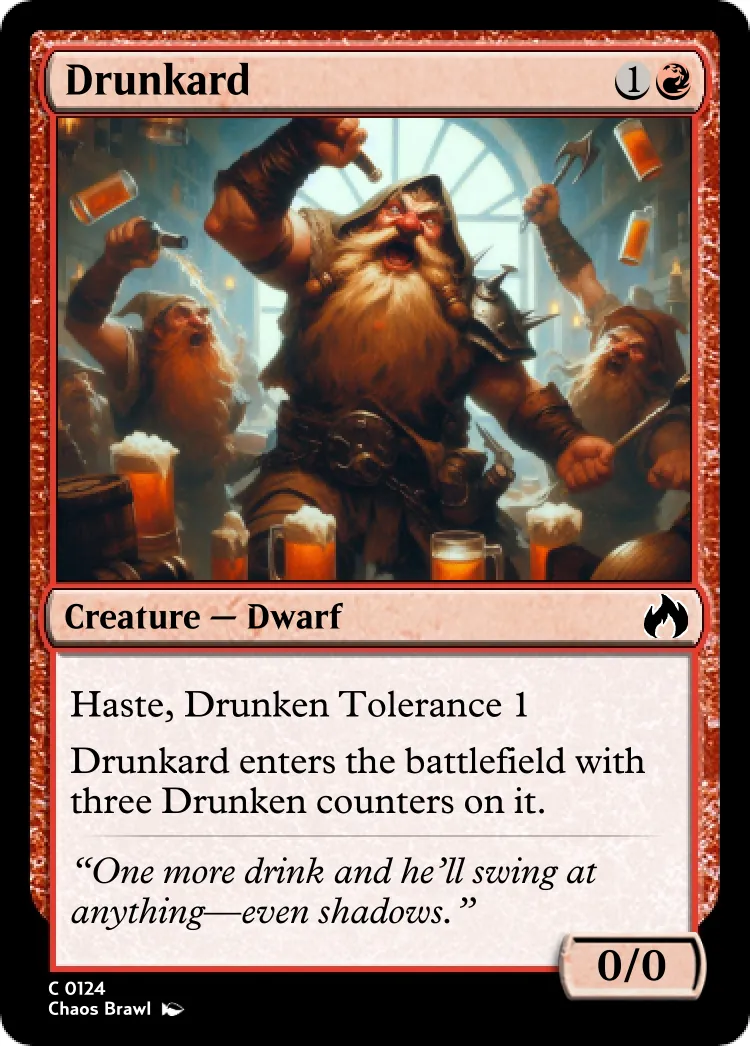
Example card
Drunkard
Mana cost: 1R
Creature — Dwarf
Haste, Drunken Tolerance 1 Drunkard enters the battlefield with three Drunken counters on it.
0/0
- The bonus applies immediately. A creature does not have to consume Beer itself; any effect that puts a Drunken counter on it makes it Drunken.
- Drunken counters are a distinct counter type. Ordinary +1/+1 counters do not make a creature Drunken and do not count toward its Drunken Tolerance. Keep the two types visibly separate even though both give the same power and toughness bonus.
- A spell or ability that refers to a “Drunken creature” means a creature with at least one Drunken counter. The amount of Beer you control and the creature’s tolerance do not determine whether it is Drunken.
- A creature can receive counters above its tolerance. Tolerance is not a maximum number of counters it can have; it determines what happens at the beginning of its controller’s turn.
- Removing the last Drunken counter means the creature is no longer Drunken. It also loses the power and toughness bonus from the counters removed.
Drunken Tolerance
Custom set rule
Every creature has a default Drunken Tolerance of 2. A printed Drunken Tolerance value replaces that default; an effect that increases tolerance modifies the applicable value.
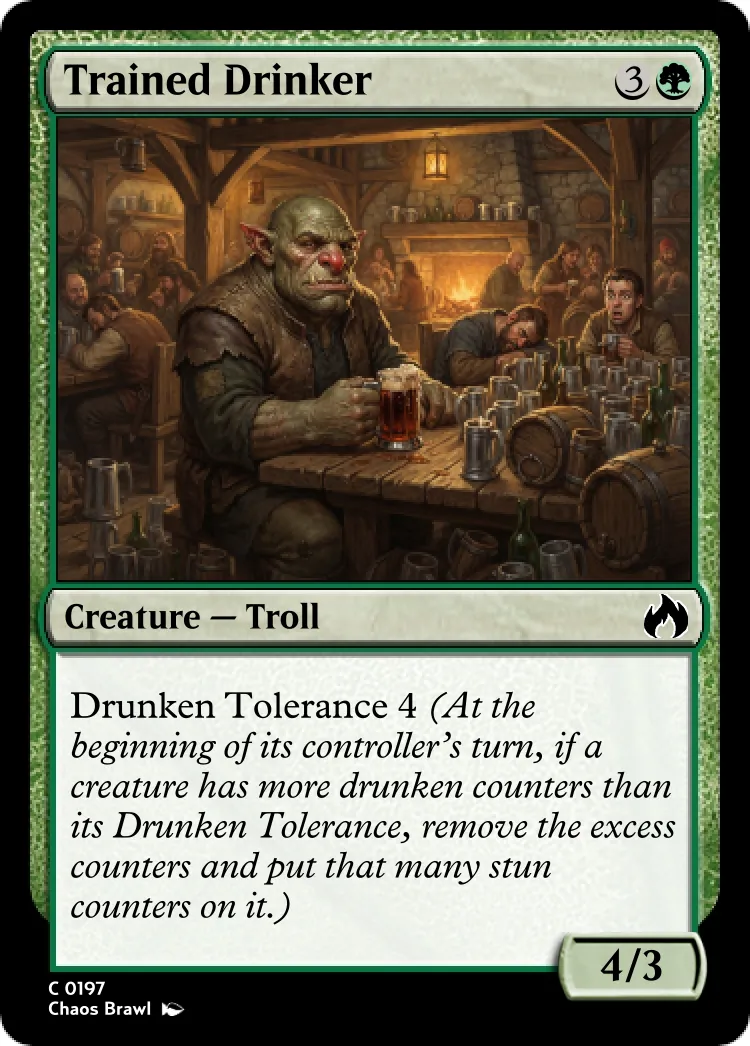
Example card
Trained Drinker
Mana cost: 3G
Creature — Troll
Drunken Tolerance 4 (At the beginning of its controller’s turn, if a creature has more drunken counters than its Drunken Tolerance, remove the excess counters and put that many stun counters on it.)
4/3
- At the beginning of your turn, before your permanents untap, check each creature you control. If a creature has more Drunken counters than its tolerance, remove the excess Drunken counters, tap it, and put that many stun counters on it.
- This check takes place before the untap step’s normal untapping. It is not an upkeep trigger. You cannot wait for the upkeep to remove counters or raise tolerance in time for this turn’s check.
- Only the excess counters are removed. A creature at or below its tolerance keeps all of its Drunken counters and is not tapped or given stun counters by this rule.
- Use the creature’s tolerance at the time of the check. Receiving more Drunken counters or changing tolerance later in the turn does not cause an immediate second check.
- A creature that is already tapped still loses its excess counters and receives stun counters. Being tapped does not avoid the consequence.
Beer Tokens and Variants
New artifact subtype
Beer is an artifact subtype used by this set. An instruction to create a Beer token creates the baseline token below. Named variants have the additional effects listed in the table.
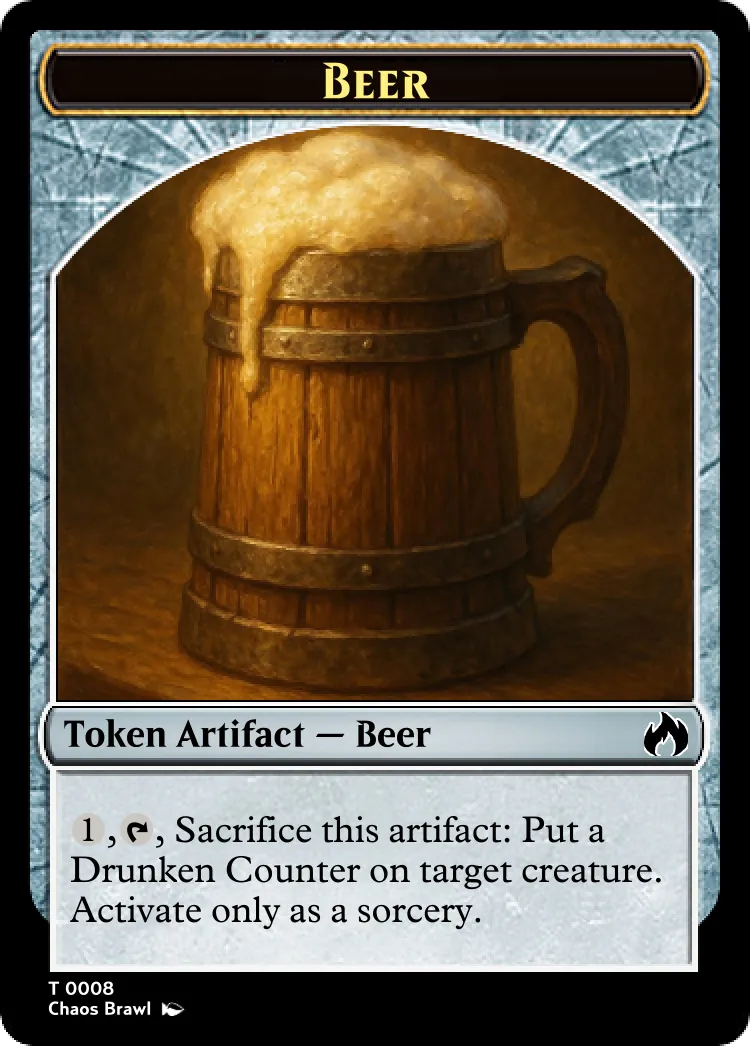
Example card
Beer
Artifact — Beer
{1},{T}, Sacrifice this artifact: Put a Drunken Counter on target creature. Activate only as a sorcery.
| Beer | Effect after paying the activation cost |
|---|---|
| Beer | Put a Drunken counter on target creature. |
| Expired Beer | Put a Drunken counter on target creature. That creature gets −2/−2 until end of turn. |
| Pils Beer | Put a Drunken counter on target creature. It gains first strike until end of turn. |
| Zwickl Beer | Put a Drunken counter on target creature. It gains haste until end of turn. |
| Wheat Beer | Put a Drunken counter on target creature. It gains vigilance until end of turn. |
| Dark Beer | Put a Drunken counter on target creature. It gains menace until end of turn. |
| Bock Beer | Put a Drunken counter on target creature, then double the number of Drunken counters on it. |
- Activate a Beer token only during your main phase while the stack is empty and you have priority. It can target any creature, including one an opponent controls.
- Tapping and sacrificing Beer are costs. The token is sacrificed before players can respond to the ability. You cannot sacrifice the same Beer to pay for another ability.
- Sacrificing Beer to a different spell or ability does not activate its printed ability. You get only the effect of the instruction for which it was sacrificed.
- If the targeted creature is no longer a legal target when the ability would resolve, none of that ability’s effects happen. Its costs are not refunded.
- All listed variants have the Beer subtype. An instruction that specifically requires a Beer token cannot be paid with a nontoken Beer permanent.
- For Bock Beer, add the first counter before counting the counters to double. Extra counters can put the creature above tolerance, but the tolerance check still waits until its controller’s next turn.
Obsession Counters
New mechanic
A creature with one or more Obsession counters must attack each combat if able. Whenever it attacks, remove one Obsession counter from it. To obsess a creature means to put an Obsession counter on it.
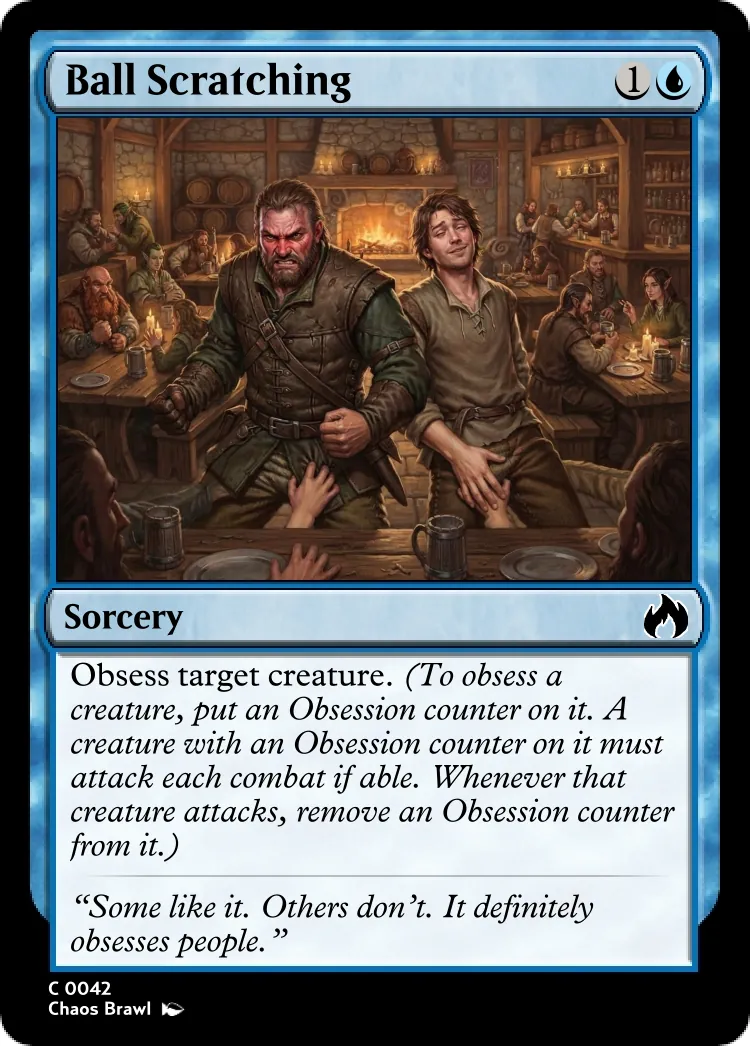
Example card
Ball Scratching
Mana cost: 1U
Sorcery
Obsess target creature. (To obsess a creature, put an Obsession counter on it. A creature with an Obsession counter on it must attack each combat if able. Whenever that creature attacks, remove an Obsession counter from it.)
- The creature’s controller still chooses which opponent, planeswalker, or battle it attacks, subject to the normal attack restrictions. Obsession does not choose a defender or change control of the creature.
- A tapped creature, or one that cannot attack for another reason, is not forced to attack. Obsession does not give haste or override a restriction that prevents attacking.
- If attacking requires a payment, Obsession does not force the controller to pay it. If the payment is not made, that creature does not have to attack.
- Remove only one Obsession counter for an attack, regardless of how many it has. If it cannot attack, it keeps its counters.
- The requirement applies in additional combats too. A creature with another Obsession counter must attack again if it can.
Upkeep Costs
New mechanic
Upkeep on a card represents a recurring obligation. At the beginning of your upkeep, perform the requirement printed after the label. If you do not, sacrifice that permanent.
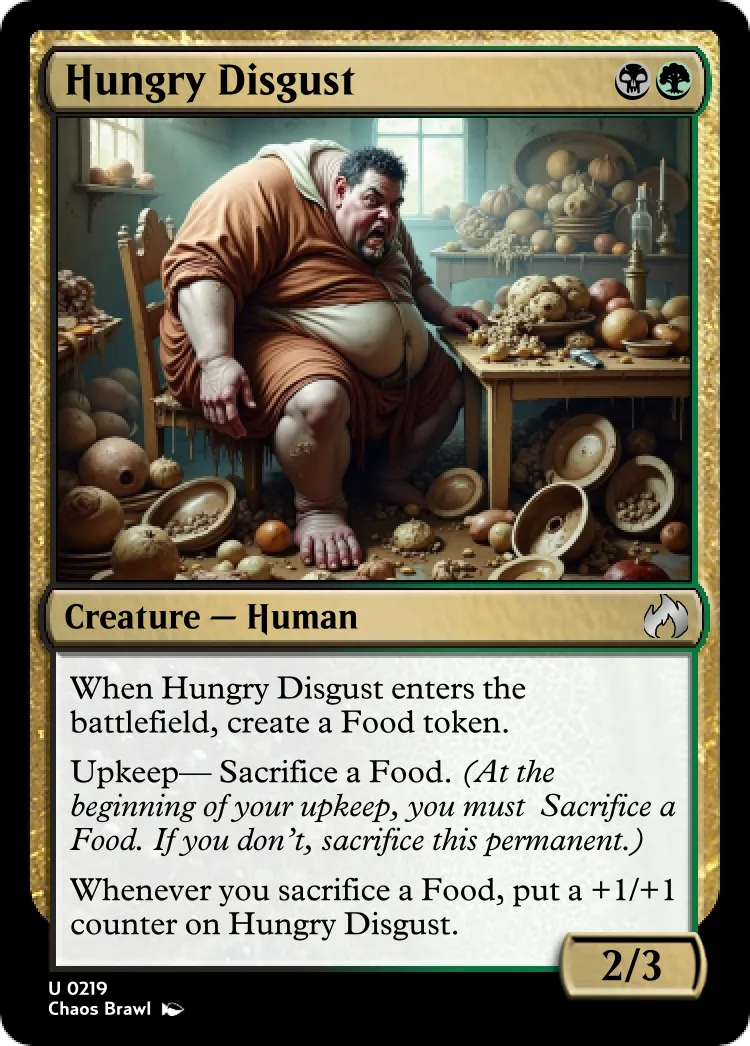
Example card
Hungry Disgust
Mana cost: BG
Creature — Human
When Hungry Disgust enters the battlefield, create a Food token. Upkeep— Sacrifice a Food. (At the beginning of your upkeep, you must Sacrifice a Food. If you don’t, sacrifice this permanent.) Whenever you sacrifice a Food, put a +1/+1 counter on Hungry Disgust.
2/3
- The requirement is determined by the card. It may be mana, sacrificing a permanent, removing a counter, losing life, or another printed action. There is no universal upkeep amount.
- Each permanent’s upkeep obligation is handled separately. One payment or sacrificed Food does not satisfy the upkeep of several different permanents.
- Resolve the obligation during the upkeep, after the untap step. The tolerance check has already happened, so removing a Drunken counter for upkeep cannot prevent stun counters from that turn’s check.
- Sacrificing a Food or Beer for upkeep does not activate that artifact’s ability. It can trigger abilities that watch for the sacrifice.
- A modifier to upkeep costs applies only to those costs, not to every spell or ability used during the upkeep. Follow the wording of the modifier, including any restrictions on how mana may be spent.
- Unlike cumulative upkeep, an older Magic mechanic, Upkeep does not add age counters or multiply its cost as turns pass. Cumulative upkeep adds an age counter each upkeep and requires its cost once for each age counter; this set’s Upkeep requires the printed payment only once each upkeep. For example, Upkeep {B} costs {B} each turn, while cumulative upkeep {B} normally costs {B}, then {B}{B}, then {B}{B}{B}. Apply any cost modifiers separately.
Locations
Custom enchantment subtype and set rule
Locations are enchantments representing places in the Foul Realms. Each player may control only one Location at a time, regardless of its name.
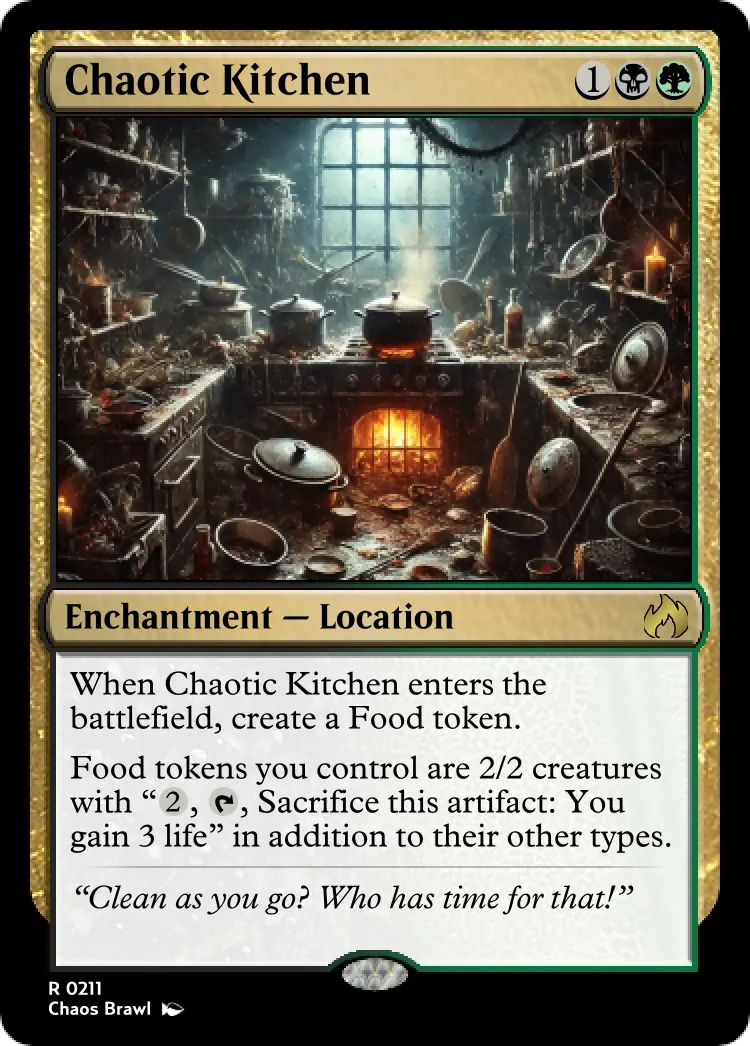
Example card
Chaotic Kitchen
Mana cost: 1BG
Enchantment — Location
When Chaotic Kitchen enters the battlefield, create a Food token. Food tokens you control are 2/2 creatures with “{2}, {T}, Sacrifice this artifact: You gain 3 life” in addition to their other types.
- If you control more than one Location, choose one to keep and put the others into their owners’ graveyards. Apply this as a state-based action, before a player receives priority.
- The rule applies whether an additional Location enters under your control or you gain control of a Location already on the battlefield. You may keep the new Location or the old one.
- Putting a Location into a graveyard this way is not a sacrifice or destruction. Indestructible does not stop it, and it does not satisfy a cost that requires a sacrifice.
- An ability that triggers when a Location enters still triggers even if you choose not to keep that Location. The trigger is put onto the stack after the Location choice has been handled.
- The restriction is per player. Different players may each control a Location, including Locations with the same name.
Food Tokens, Cards, and Creatures
Returning artifact subtype with custom creatures
Food appears as tokens, artifact cards, and mutated creatures in this set. A card’s types and text determine how it can be used.
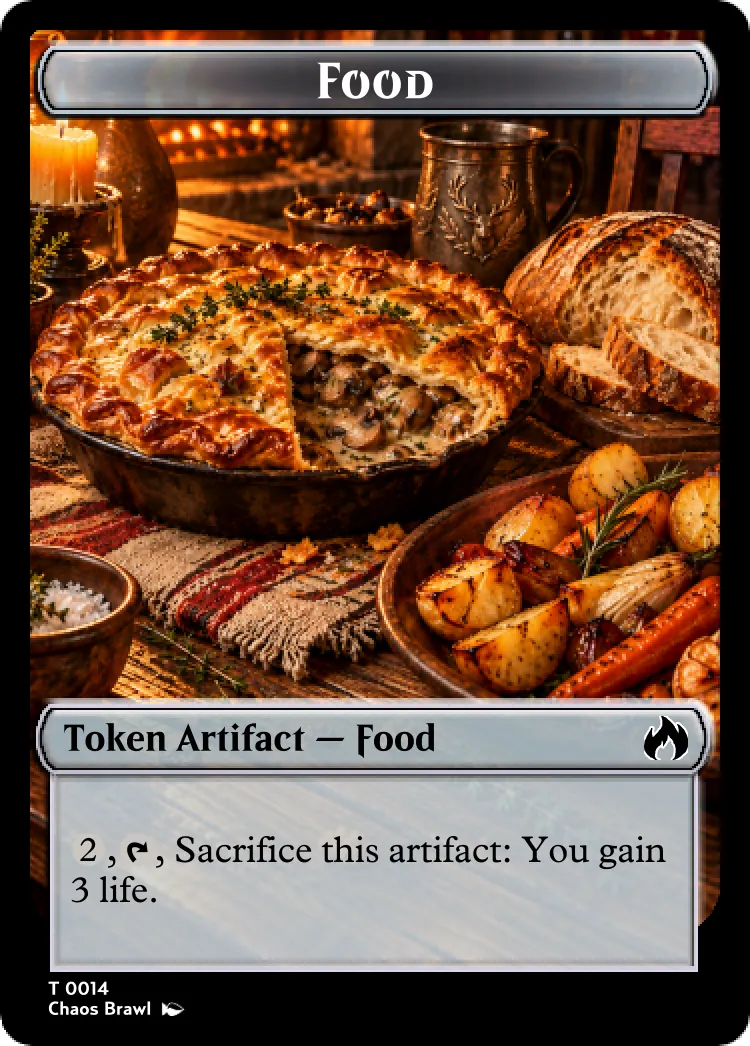
Example card
Food
Artifact — Food
{2},{T}, Sacrifice this artifact: You gain 3 life.
- The Food subtype alone does not grant the token’s activated ability. A nontoken Food card has the abilities printed on it.
- An effect requiring a “Food” can use a Food permanent with the appropriate subtype, including the set’s custom Food creatures. “Food token” and “Food artifact” are narrower requirements.
- Activating a Food token uses the stack and can be done whenever you have priority. Sacrificing it for a different cost does not gain 3 life.
- When a Food becomes a creature, it keeps its other types unless the effect says otherwise. As a creature, it must obey the normal rules for attacking and for abilities with a tap symbol in their cost.
- A Food card in a graveyard can be returned by an effect that asks for a Food card. A token cannot remain there to be returned.
Stun Counters
Returning mechanic
Stun counters are a returning mechanic used frequently in The Foul Realms. They have their own section because Drunken Tolerance turns excess Drunken counters into stun counters. Stun counters delay untapping; they do not reduce power or toughness.
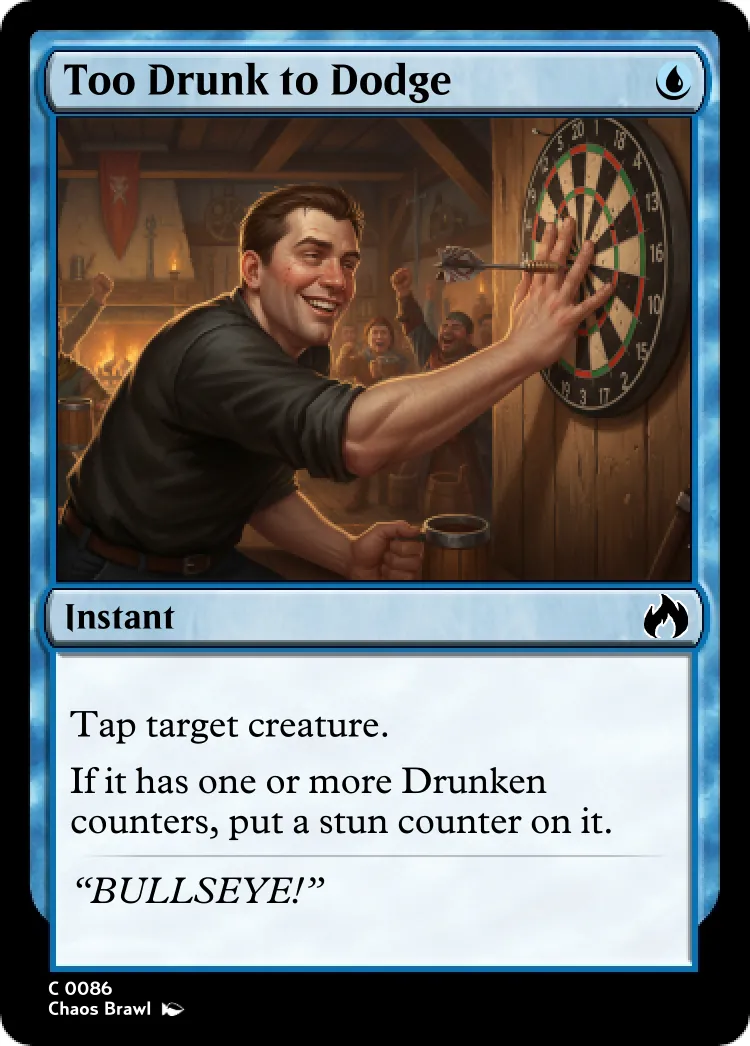
Example card
Too Drunk to Dodge
Mana cost: U
Instant
Tap target creature. If it has one or more Drunken counters, put a stun counter on it.
- During the tolerance check, remove the excess Drunken counters, tap the creature, and put that many stun counters on it. It immediately loses the power and toughness bonus from the Drunken counters removed. Its normal untap then removes one stun counter instead of untapping it.
- Each time a permanent with a stun counter would untap, remove one stun counter instead. Multiple stun counters do not all disappear during a single untap.
- This applies to untapping from spells and abilities as well as the normal untap step. Putting a stun counter on a permanent does not itself tap it.
Other Returning Mechanics
Rules reminders
The set also uses familiar Magic mechanics alongside its custom rules. These reminders focus on the interactions most likely to arise during play.
Exhaust
Each exhaust ability may be activated only once for that permanent, even if the ability is countered. Different exhaust abilities have separate limits. Leaving the battlefield and returning makes a new object and resets the limit; changing controllers does not.
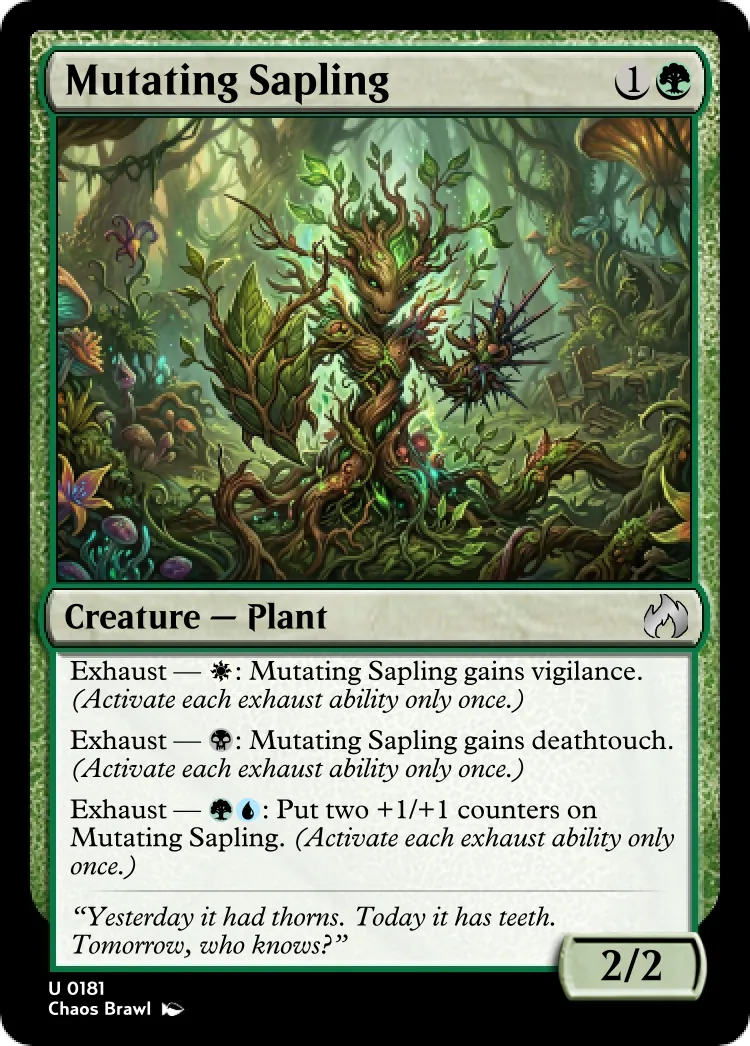
Example card
Mutating Sapling
Mana cost: 1G
Creature — Plant
Exhaust — {W}: Mutating Sapling gains vigilance. (Activate each exhaust ability only once.) Exhaust — {B}: Mutating Sapling gains deathtouch. (Activate each exhaust ability only once.) Exhaust — {GU}: Put two +1/+1 counters on Mutating Sapling. (Activate each exhaust ability only once.)
2/2
Sagas
A Saga gets a lore counter as it enters and as your first main phase begins. Its matching chapter abilities trigger and use the stack. After its final chapter, sacrifice it once none of its chapter abilities remain on the stack. Use the highest chapter number printed on that Saga, which is not always III.
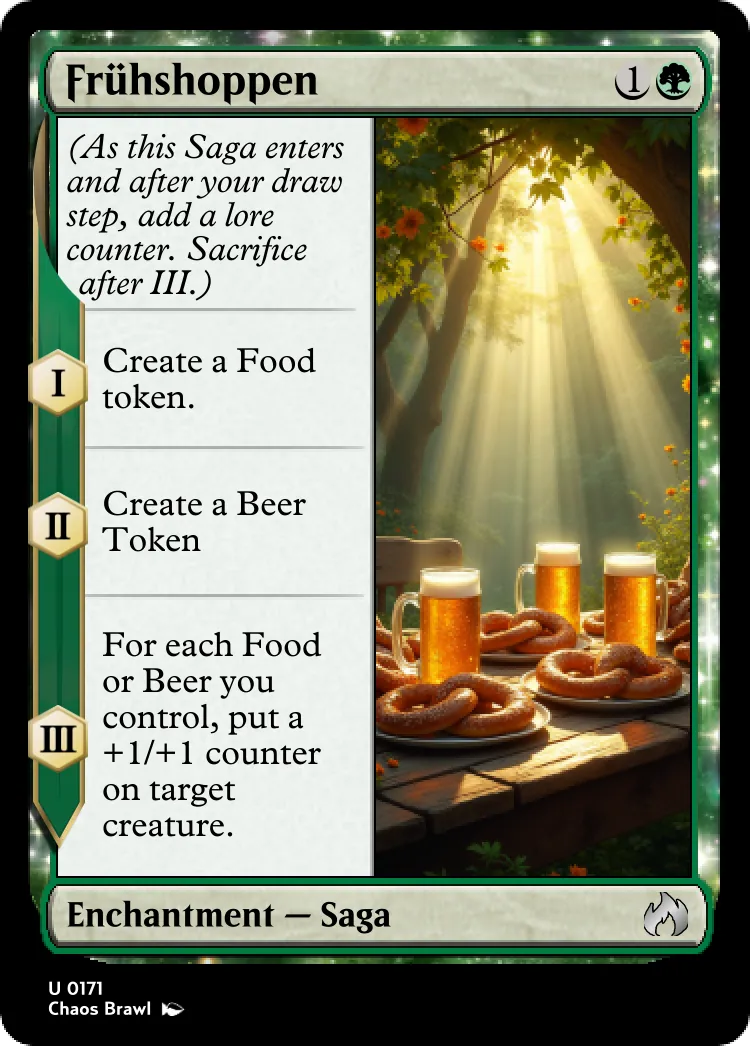
Example card
Frühshoppen
Mana cost: 1G
Enchantment — Saga
I — Create a Food token. II — Create a Beer Token III — For each Food or Beer you control, put a +1/+1 counter on up to one target creature.
Affinity for …
Affinity is a returning keyword that reduces a spell’s generic mana cost by {1} for each permanent you control of the specified kind. The Foul Realms introduces affinity for Beer, using the new Beer subtype. All Beer permanents count, including named variants; colored mana requirements remain unchanged.
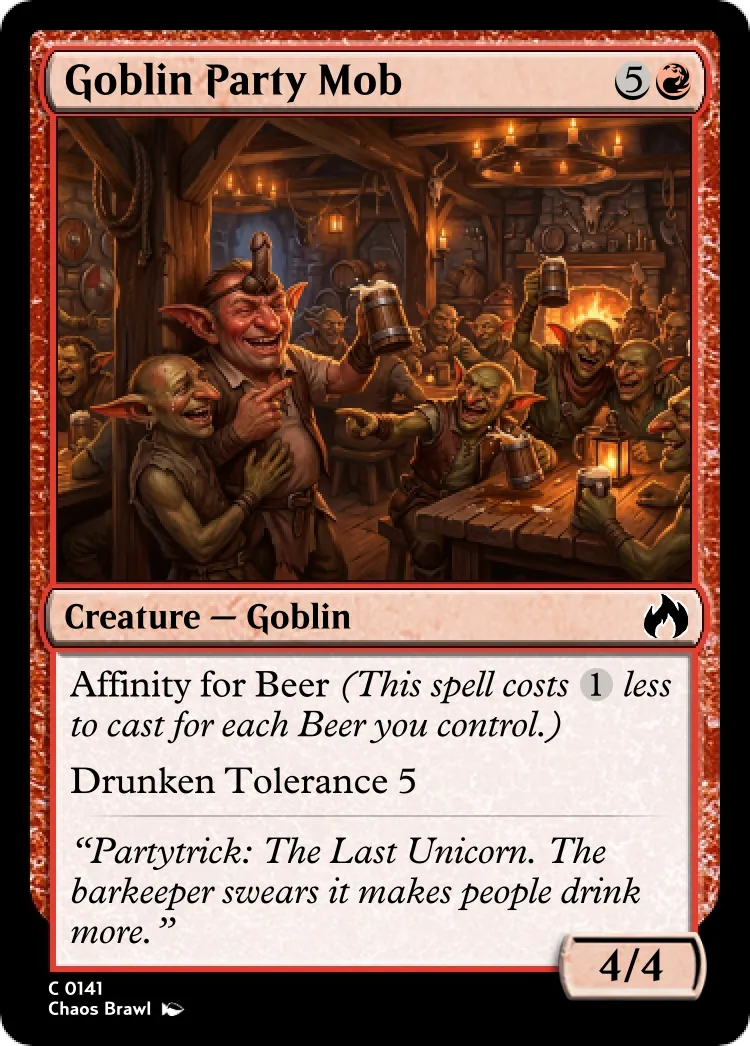
Example card
Goblin Party Mob
Mana cost: 5R
Creature — Goblin
Affinity for Beer (This spell costs {1} less to cast for each Beer you control.) Drunken Tolerance 5
4/4
Landcycling
Pay the printed cost and discard the card from your hand to search for a land with the specified land type. Reveal that land, put it into your hand, and shuffle. A nonbasic land with that type can qualify.
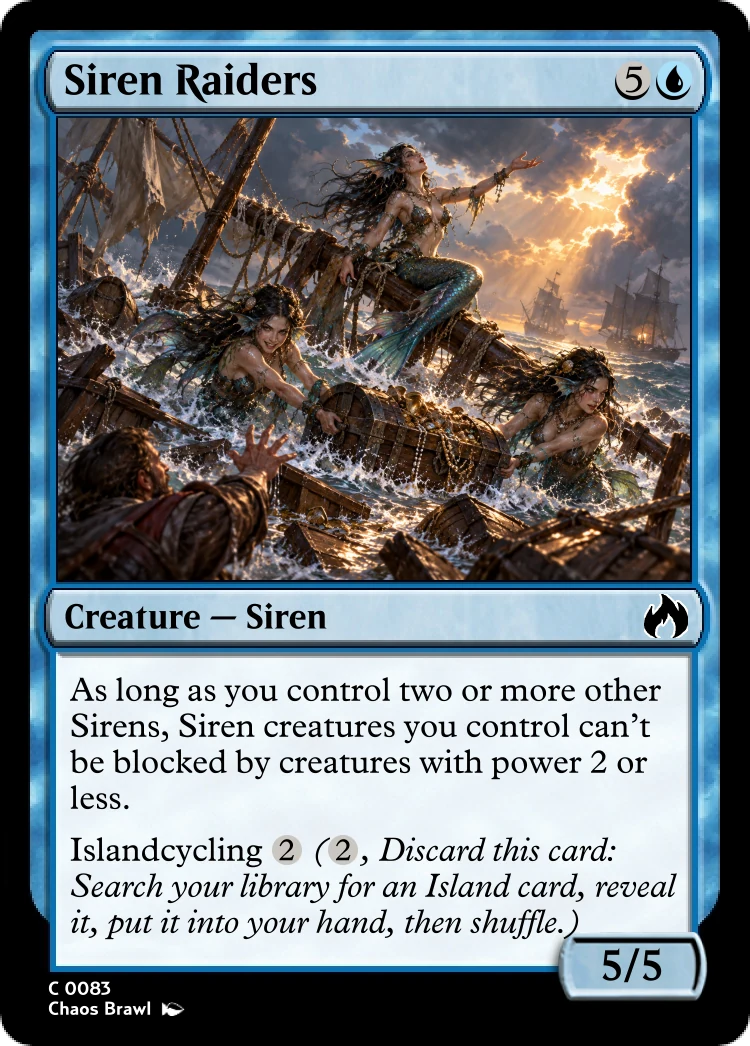
Example card
Siren Raiders
Mana cost: 5U
Creature — Siren
As long as you control two or more other Sirens, Siren creatures you control can’t be blocked by creatures with power 2 or less. Islandcycling {2} ({2}, Discard this card: Search your library for an Island card, reveal it, put it into your hand, then shuffle.)
5/5
Kicker
Choose and pay the printed additional cost while casting the spell. Follow the card’s instructions for the reward and for any choice of how many permanents to sacrifice.
Finality counters
If a permanent with a finality counter would go from the battlefield to a graveyard, exile it instead. The counter does not give it any power or toughness bonus.
Rolling dice
Use the die specified by the effect and follow the row matching its result. Resolve the instructions in order; other players cannot interrupt the resolution between the roll and its outcome.
The Foul Realms is in playtesting. Report unclear wording and unexpected interactions on the Tavern Board so future revisions can address them.
← Return to announcement