Page width 1160px maximum
Choose a width or use the slider. On desktop, you can also drag either page edge. The page always fits your screen.
VOLUME I · THE FOUL REALMS
A STORY FROM THE CHRONICLES
No Supper in Auenbruck
Aldren and Berrik · Story 1
The roads of the Foul Realms passed through mountain settlements, river towns and forests where some of the things growing beside the path could decide to follow a traveler home. Dwarves worked the high country, sirens inhabited the waters, and people of many kinds shared the roads between them. Towns offered work, company and a reasonable expectation of supper.
Before Supper
Ten years had passed since the happening people called the Great Unraveling. They remembered little of the happening itself. Much of what came before was missing too, or confused: a face without a name, a room that might have belonged to someone else, a familiar voice with no words left in it. A cooper could still make a barrel without remembering who had taught her. A musician could play a tune whose first hearing had disappeared entirely.
Some people claimed to remember more. Others had enough to occupy them in the years they could account for. Houses had been repaired, roads reopened and shops established. Strange things continued to happen, and ordinary business continued around them until it could not.
In Auenbruck, that point arrived shortly before supper.
The town stood beside a river, with farms beyond its last houses and a bridge busy enough to make the nearest taverns profitable. Aldren Veyr had chosen the Copper Kettle because he could hear conversation through its open windows. Conversation meant customers, and customers sometimes meant a meal for a musician.
He had played three songs and been asked to shorten two of them. Nevertheless, a gnome at the table beside the hearth had listened with his elbows planted and his head tilted appreciatively. When Aldren rested his lute and asked why a brewer would bring a ladder to a tavern, the gnome looked up at once.
“Because the ale was on the house.”
The gnome laughed until he had to put down his mug.
Nobody else did. Aldren scarcely noticed. He had spent much of the afternoon looking for a response of any kind, and this was an excellent one.
The gnome introduced himself as Berrik Thornwick and moved his coat from the bench. Aldren accepted the place. They discovered a shared preference for warm rooms, generous portions and people who appreciated a little entertainment.
Berrik also appreciated Ilva, the woman keeping the Kettle. He followed her progress through the room with an attention he had not given the words of any song. While Aldren tuned a stubborn string, Berrik rested a hand at her waist as she leaned to collect an empty plate. Ilva took his wrist and returned the hand to the table.
“That can stay there.”
Berrik kept it there. Aldren, occupied with the string, looked up when she set a wooden shutter across the kitchen hatch.
There would be no supper, she announced. There was no food left. The kitchen was closing, and until another delivery arrived, so was the Kettle.
Someone asked about the stew. Ilva lifted the lid of a pot she had brought from the kitchen. A sour smell moved through the room. She replaced it before anyone asked again.
The meat had arrived that morning. Her cheese had gone soft, the onions were wet inside, and she had cut three loaves open to find dark patches running through the crumb. She had tried different shelves and a different cellar. Yesterday's food had lasted half as long as it should. Today's had scarcely lasted at all.
Berrik inspected his empty plate.
The bell on the Hauptplatz began to ring.
Headquarters
By the time they reached the square, the doors of the wagon house were open and Maerla, who kept her carts there, was calling for people to stop shouting long enough to hear one another.
The wagon house held ladders, spare beams, buckets and several things whose owners could only be found when somebody else wanted to borrow them. People called it Headquarters. When a roof failed or a cart overturned on the bridge, somebody went there first.
This evening a bell and three closed kitchens had brought half the surrounding streets.
Maerla had begun by asking who had lost food. Too many hands had gone up for that to be useful. Now she was asking when it had happened and where the food had been kept.
A baker blamed the flour merchant. The merchant's daughter had eaten bread made from the same sack at breakfast, which she said proved something was wrong with the baker's cellar. A vegetable grower laid a split turnip on a cart and asked whether flour had done that too.
Their accounts were angry, particular and, as far as Aldren could tell, sincere.
Maerla needed people to inspect the stores, find somewhere safe for the next deliveries and work out what was happening. Anyone with sound food was asked to keep it out of the affected streets for the night.
There was no purse waiting for volunteers. Ilva stood beside her ruined onions with her sleeves rolled up. The baker had flour to replace and nobody to sell bread to. Across the square, someone was shutting the door of another eating house.
Berrik asked whether Aldren intended to help.
Aldren had been considering the same question. He could leave in the morning, but leaving meant another road, another search for a room, and no particular reason to expect supper before then. He said he would help if Berrik did.
They joined Ilva on the walk back to the Kettle.
The first useful thing Berrik knew was that he had eaten a perfectly good pear shortly before arriving there. He had bought it near the bridge. The grower's remaining pears, when they went to look, were firm and sweet.
The grower had supplied the basket Ilva bought that morning.
They carried two pears back toward the Kettle. At the bakery, Aldren stopped to listen again to the argument about the flour. The floor beneath the kneading tables had been warm for years without spoiling a sack. It was the new patch by the cellar steps that worried the baker: damp stone, a bad smell and a soft scraping beneath it.
Ilva had heard scraping too.
Aldren began asking people to show him rather than tell him where the food had spoiled. By the time the lamps were lit, they had visited a cool pantry, a warm cellar and a covered stall. Each stood beside an old drain. The pear stall near the bridge stood farther from one.
One of the pears they were carrying had developed a dark mark beneath Aldren's thumb.
He held it out. Berrik took it by the stem, watched the skin wrinkle, and stopped smiling.
Beneath the Bakehouse
Torra, a dwarf who repaired presses and millwork, knew the drains. She had spent much of the previous winter clearing one after a retaining wall fell into it. At Ilva's request she brought a lantern and led them to a low stone opening behind the bakehouse.
They heard something feeding before they saw it.
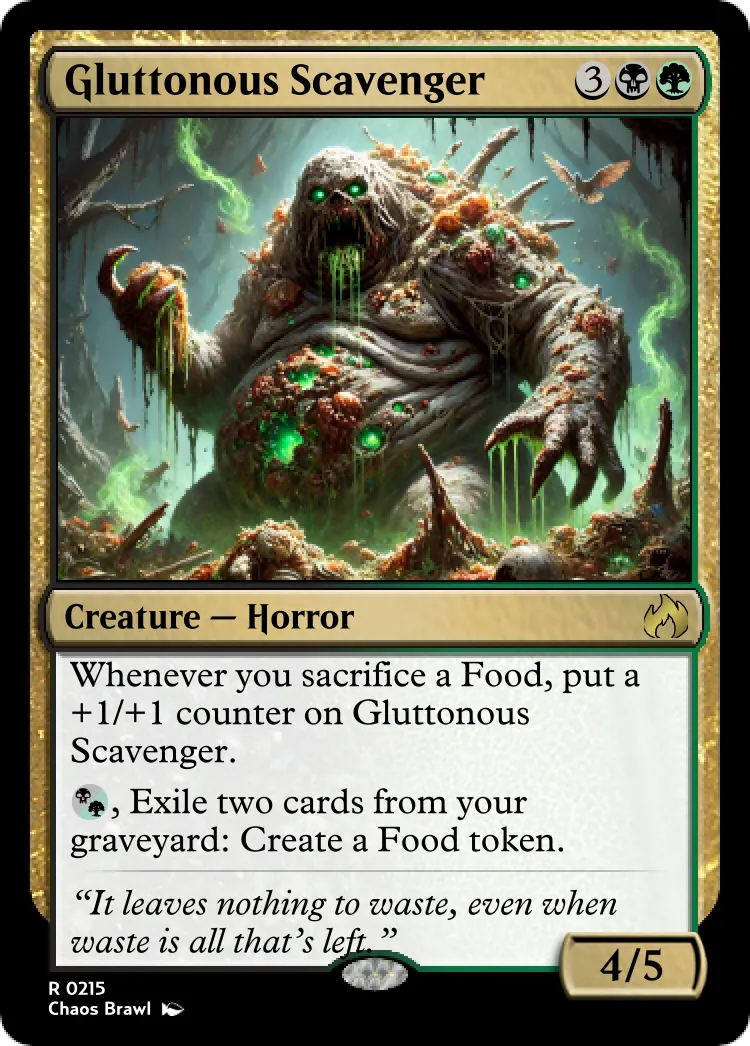
A gluttonous scavenger came into the lantern light on thick arms, dragging a pale, swollen body over the rubbish gathered in the channel. Orange growths crowded its shoulders. Green light showed in pits beneath its skin, and strands of wet matter hung from a mouth sunk deep into its face. A broken hoop from a refuse barrel had caught around one wrist.
Its shoulders nearly filled the channel.
Aldren stepped back so sharply that the lute struck the wall behind him.
The creature turned its head. For a moment its mouth opened toward the sound. Then it lowered itself over the refuse again.
Berrik had brought a piece of sound cheese wrapped in cloth. As they watched, a bead of greasy moisture appeared on its cut face. The smell followed. He set it down and withdrew his hand.
The creature left a bare apple core to drag the cheese into its mouth.
Torra pulled both travelers away from the opening.
They returned with Maerla and a grower carrying a basket of pears. Nobody went into the channel. From the top of the steps they laid out a few pieces of fruit, one well back from the mouth and another nearer it.
The nearer piece browned first. The creature ignored it until its flesh had softened. Then it reached out, swept the pulp into its mouth, and settled closer to the opening.
The fruit farther back began to change. Aldren could not tell whether the creature's reach was increasing or whether it had simply moved close enough. Either way, he carried the basket back up the steps.
Maerla fetched the boy who helped collect kitchen waste. For several days he had tipped the town's increasing spoilage through a broken cover rather than haul it all the way to the old pits. He had been told to clear it away quickly. Everyone had wanted it gone.
The heaps in the channel had disappeared each morning. He had thought the water was taking them.
Torra said something quietly in Dwarvish. She stopped the waste cart herself when it came down the lane.
They still did not know where the creature had come from. They knew it was eating what the town threw away, and that sound food spoiled when it approached. There was plenty of food left on the farms. Bringing it into these streets would feed the thing beneath them.
For that night, they covered the drain, kept people away and carried what remained of their supplies to the dry ground above the bridge.
There was bread there, and a little smoked meat shared among too many people. Aldren ate sitting on a folded sack. Berrik sat beside him with his hands clasped between his knees.
After a while, Berrik asked whether he knew another joke.
Aldren admitted that he knew several.
“The ladder one,” said Berrik.
Aldren looked at him, then smiled for the first time since the cellar.
The Old Press
By morning, Maerla had people watching the drain covers and keeping food carts outside the affected lanes. Torra returned from the far bank with the owner of an old fruit press.
The press had been waiting for repairs since the harvest. Its stone weight was held up on timber supports, with its tray open below. Torra had meant to lower the weight once the damaged frame was ready to be taken apart.
She could lower it over something else first.
The press house stood beyond the last riverside stores. The drain behind the bakehouse opened onto a bank from which the creature could reach it. Getting the thing there would be the dangerous part.
Berrik asked what would happen if it preferred the kitchens.
Maerla said the kitchens would be empty. Every scrap would go to the press house. Ilva had already begun collecting it.
They spent the day making one route easier than the others. Torra and the press owner inspected the old frame. Carters moved spoiled stores. People who had argued in the square worked together over drain covers, quarrelling now about how best to lift them. Ilva carried out the last of her ruined food and scrubbed the Kettle's kitchen with the door open.
Aldren helped pull a loaded cart. Berrik helped him until Ilva passed, when he offered to take her basket too. She gave him the heavier one.
It was late afternoon when Torra walked them through the press house. They would leave the largest heap of spoiled food on the tray beneath the stone. The outer doors would stay open. Once the creature entered, nobody was to approach it.
The people lowering the weight would work from behind the side wall, where they could not see the tray. Someone had to tell them when it was occupied.
Aldren could see the tray from an opening in the loft. He could also see Maerla beside the wall outside. He would give a note on the lute when the creature was in place. She would carry the signal to Torra.
Berrik would wait outside with her.
He considered this arrangement, then asked Aldren whether he was certain he could reach the loft stairs quickly.
Aldren went up and came down again to make sure.
At dusk they opened the channel.
One Clear Note
The creature followed the spoiled food slowly. It paused over every heap, settling its weight with a wet scrape before feeding. Aldren watched from the press house as lanterns were withdrawn along the bank. The townspeople kept behind the carts and walls they had chosen beforehand.
It had looked large in the drain. Out in the fading light, he could see the whole swollen body and the powerful shoulders dragging it forward. He wished they had found a different opening in the loft, one farther from the floor below.
The smell reached him before the creature did.
It stopped at the doors.
Aldren could see the bait beneath the weight. So could the creature. It lifted itself a little, drawing air through its open mouth, and one hand closed around the doorpost.
The wood creaked.
Outside, Berrik had started to move. Maerla caught his sleeve. He pointed toward the tray, then at the small heap caught against the threshold.
The creature bent over that nearer meal.
They had left it too much food at the entrance.
Aldren waited. His fingers ached around the neck of the lute. The creature ate, rested, and scraped at the stones for fragments. It reached one arm into the press house, raking loose refuse toward itself.
Then it settled across the doorway.
Berrik slipped away from Maerla. He came along the outside wall carrying a small tub and climbed the low steps to the press house's storage hatch. Aldren had seen Ilva empty that tub into the bait cart. Berrik had fetched what remained.
He tipped it through the hatch.
Aldren saw the mess land close to the main heap. The creature lifted its head, pulled itself over the threshold and followed.
But Berrik was still at the hatch, struggling to pull the empty tub free of a splintered board. One of the creature's hands swept out. The door struck the wall hard enough to shake dust from the loft.
Aldren missed the string on his first attempt.
He forced his hand still. Berrik's hand vanished from the hatch. The creature hauled its swollen middle onto the tray, and Aldren sounded the note.
Maerla raised her arm.
Behind the wall, Torra called to the others.
The frame answered with a deep wooden groan. The creature raised its head. Aldren was already moving toward the stairs when the weight came down.
The blow shook the floor beneath him. His shoulder struck a post. Somewhere outside, people shouted, and the creature gave a sound he felt through the soles of his feet.
He went down the last steps on his hands and knees.
Berrik lay beyond the storage hatch with Maerla bent over him. Aldren ran across the yard and stopped so abruptly that the lute swung against his hip.
Berrik opened one eye. He had torn his sleeve, scraped his cheek and cut his palm on the splintered hatch. The fall had knocked the breath out of him.
He wanted to know whether it had worked.
Torra kept everyone away from the press house until the movement beneath the weight had stopped. She would make no promises before then.
Aldren sat on the ground beside Berrik. The gnome's hand was shaking. After a moment, Aldren realized his own was too.
They stayed there until Maerla came to tell them the creature was dead.
Supper
They tested sound food around the press house before anyone brought a cart back into Auenbruck. Pears remained firm. A piece of cheese cut at dawn was still good when Ilva inspected it that afternoon. The stores nearest the drains smelled of soap and scraped stone.
The spoiled food remained spoiled. It had to be cleared away, and the press house still held work nobody wanted. Torra and Maerla organized that work while the first safe deliveries entered the town.
By evening, the Copper Kettle's kitchen hatch was open.
Ilva set two bowls before the travelers. There were onions in the broth, thick slices of bread beside it and enough food left in the kitchen for the next table.
Berrik thanked her. His bandaged hand stayed beside his bowl.
Aldren ate until the tightness in his stomach eased. Across the room, a carter was describing the creature as taller than the press house. The press owner corrected him. Both agreed it had been fortunate that everyone had listened to the plan, although Aldren could remember several moments when nobody had.
He looked toward the hearth, where his lute rested with a split along one edge.
Berrik offered to help carry it to someone who could mend it. Then he asked which road Aldren intended to take when he left.
Aldren had heard there were good taverns farther along the river. He had meant to find out for himself.
That suited Berrik. He had nowhere he needed to be the next morning, and he preferred traveling with company.
They agreed to go when the lute was mended.
A man at the next table asked whether Aldren was the musician. Aldren said he was, and the man asked if he knew anything short.
Beside him, Berrik began to smile.
Aldren set down his spoon.
“Why did the brewer bring a ladder to the tavern?”
Berrik was laughing before he finished.